

Since the beginning of time, at the core of our human experience has been visuals. The oldest known cave paintings were made at least 64,000 years ago by Neanderthals in the Spanish caves of La Pasiega Maltravieso and Ardales (Little,2025). There are so many cave paintings that portray animals, people, and landscapes that we guess the stories only because we ourselves have not experienced nature as our ancestors have.
An interesting thought regarding cave paintings is whether their lack of current techniques prohibits our capacity to interpret them correctly. Visual storytelling is the combination of emotional reaction and narrative information. The colors, typography, style, balance, and format of an image will generate that first instinctive smile or frown, attracting or repelling the gaze for reasons we don’t fully understand (Losowsky).
Cave Painting
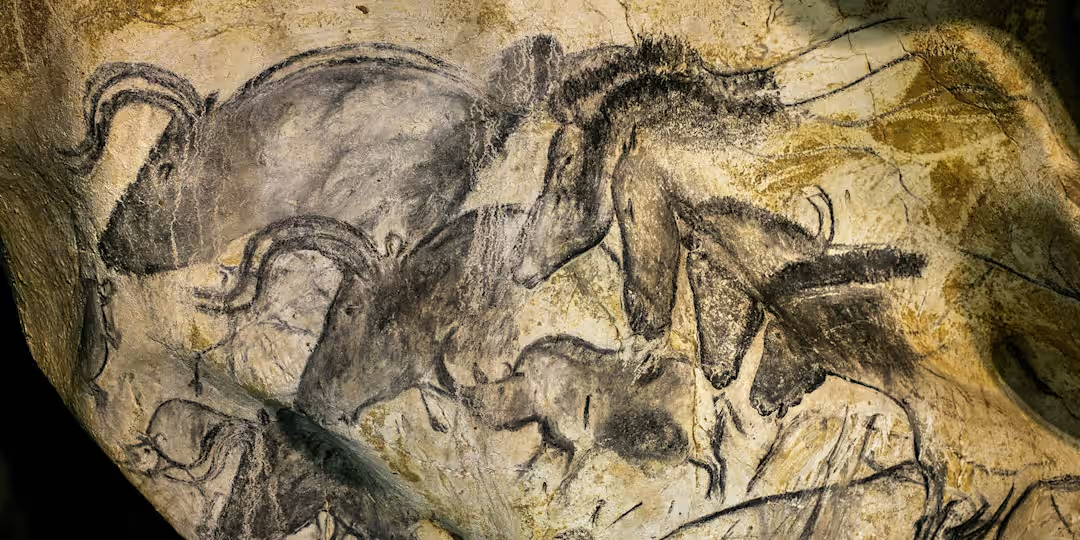
In this cave painting, we see many animals facing the same direction, looking back at us. They vary in size from Rhinos to armadillos, and they all hold a story that only their hunters and companions know. Taking all of these animals in invokes the feeling that the painter created the moments held between the humans and animals out in the wild. The animals were painted with neutral expressions, which makes the painting feel like homage to them. They serve as a reflection of life, what it takes to sustain it and the beings that make it possible. This painting was created through the non-dramatic technique; as its viewers look at the animals, we are to piece together the story.
Seeking New Grounds

It is interesting how adding more details to a painting helps us understand its context. Unlike the cave painting, this painting put humans and animals together. The wolf that is viewed at the bottom left corner, on its own, we would view as a wild animal. But seeing the wolf next to the humans and their horses, we can understand that this wolf has some level of loyalty to them. Being that it is a pack animal, it has acknowledged that the success of its survival is possible by having close proximity to these humans. All animals and humans are facing the same way, showing unity and that collectively they are all off seeking the same thing. Their horses are carrying their personal items and we see women and children, which makes this adventure seem as they are seeking a new place. The artist controlled the background by adding elements that enhanced the story being told (Gitner,2022). The sunrise in the background evokes the feelings of hope and possibility. The contrast of darker colors are used for the ground that they are leaving for greener pastures.
Rainy Day In Manhattan

Thousands of years later, we’ve moved away from nature to be closer to cities and tecnology. We all love Manhattan when the weather is beautiful, but when it rains, its landscape is completely changed. The outer appearance of large skyscrapers and buildings takes a mysterious tone as the colors are washed out by grey. The colors of the clothes of passersby are cloaked by rain jackets, the flowers on the outdoor carts are brought in, and the storefronts blend into the street sign lights. The dark shading and smudging of colors express how dark and dreary a rainy day in the city can be. The pops of color the artist used for the street and car lights are the only bits of relief from the gloom of this rainy day. We see the group huddled to the left that offers some bright blues, and they seem to be discussing the plans they made now that they’ve met up with each other. The group of people in black seem to have carried the weight of their days and are heading home. They’re hunched forward under their umbrellas, and since the direction they are facing is towards the edge of the painting, the painter communicates that they are not on the same adventure like our friend group to the left. The artist also utilized silhouette’s to communicate the wet grounds and shadows created by the rain. Though this tecnique should be used sparingly as it can be seen as cliche(Gitner,2022), this is an example of how it can add emotion to a visual.
Secret Library

The group to the right in the previous picture made me wonder where some of those people could be hurrying back to. During rainy days in the city, the mission is to run home or to our favorite comfort spots. What if this photo is the destination of one of the travelers?
The balance between light and dark in this photo invites us to this secret place. It’s organization and the health of the plants present tell us that someone comes regularly to care for this space. Although the mahogany is dark, the use of lighting speaks of its care; it is all polished, and dust is nowhere to be found. The cherry blossom peaking in through the ceiling has left no flowers on the ground, shelves, or couch for us to find. The artist also used the light to illuminate the book collection which reveals to me this was all brought together because of this caretaker’s love for learning. The artist used this interactive technique for us to find clues while we still remain in a state of mystery. The outside view only reveals more beautiful trees, there are no buildings or streets to tell us if it is out in the country or in a city. This picture invites us to steal away to our quiet place to spend time immersed in the things we love and hold close to our hearts.
Dispair

Visual storytelling is important because when our words fail us the use of visuals will always connect us just as music does. We have all experienced this moment in adult life, where all of our responsibilities, our fears, our struggles come in and surround us. There is a feeling of being overwhelmed by the darkness, which is portrayed by the black textured swirl surrounding the stick figure. What this stick figure is feeling speaks to us by how it is on the ground, and it is bent over, trying with its last bit of strength to hold itself up. The pop of red uses color therapy to communicate strong negative emotion amidst the darkness of the black textured swirl. The stick figure’s head points toward the swirl, which makes me believe all of this heaviness is being caused by its thoughts. The red space in the middle holds hope as the black textured swirl hasn’t completely consumed our stick figure.
Woman Immersed In Flowers

Moving away from our stick figure in despair, we see how a photo’s message can be changed by its color palette and surroundings. Instead of a black textured swirl, we see a woman surrounded in a field of daisies. She has on a light colored dress, and though we can not see her eyes, her smile conveys that in this moment she is experiencing happiness. Flowers have always been connected to the whimsical journey of being a woman. We see a woman who appears to be at peace with where she is currently in her life, there’s a feeling of acceptance as well. In this moment, everything is as it should be and her joy is her own. Now, if we viewed this woman with the same smile but instead she wore a black gown and was surrounded by a field of black roses, viewers would pick up on nefarious vibes. Feelings of danger would arise as something would feel off.
Person In Contemplation

Another important background choice that effects how a picture is perceived is whether it is set in the day or night. We see a person sitting down, facing away from us as the sunset is completed which reveals a full moon to us. We take the cue that this person is reflecting as we have assigned reflection to night. When the quiet of the day finds us, when everyone has gone to their homes to rest. Seeing someone taking in nature during this time leads us to believe they are processing their life and stole away to do so in peace. If this was located in a city scene, it would no longer be a pursuit of understanding or closure, it would be the beginning to a bout of avoidance.
Conclusion
Throughout history we have used photos to send messages to one another. Strong emotions can be stirred up just by a photo’s color palette, background details and focal points. The artist controls the viewer’s experience by the techniques they choose and by how the present context clues. As we continue to advance and develop new techniques it will be interesting to see how the art of visual storytelling progresses.