Categories
Visual Storytelling

Designed to Decide: How Visual Design Shapes Our Choices

Think of the last website you’ve frequented. Did you freely decide where to look first, or did the design of the website help make your decision for you?

Designers have been utilizing behavioral economics, which is the study of human decision-making, to create websites that lead users to their desired outcomes.

Design influences behavior by reducing the mental effort required to understand information, directing attention, and making certain actions feel more natural or appealing. This is done through the utilization of 5 behavioral economic principles for designers; let’s take a look at how each one affects users and their benefits.

Anchoring

Walmart Online Yarn Selection

Every Christmas I create the gifts that I give to my friends and family. One of my most requested gifts is winter scarves. Seeing that we are entering October, I thought it would be a great head start to order my yarn to complete my Christmas projects.

I headed to Walmart’s website to see what is available. Original prices are shown crossed out with the current prices shown in green next to it. Star ratings and the number of reviews are shown below the yarn names support the quality of the yarn.

The original prices set a customer’s frame of reference; they immediately latch on to it. Once customers see that the price has decreased, it will make the product feel inexpensive in comparison to its original price. This is why it was important for designers to add the star ratings and reviews to disprove that the lowered price was in result of the product’s quality.

Businesses must ensure that they display correct pricing because once a customer anchors to a price, they will pay less than it but never more.

Defaulting

Grammarly Subscription Pricing

How interesting has it been, this world that holds every subscription imaginable being thrown at us by every company. Ellen Lupton described defaulting through the scenario of a customer making a choice between three different service plans will most likely choose the middle option. Defaulting explains that people often stick with an option that’s already selected because it reduces the effort they have to make in the decision process.

Grammarly presents 3 plans that a user can choose based on their individual needs. Under each plan name, there is a short description of what will be achieved using the plan. For their middle plan, they note that it is best for students and offers a free 10-day trial to try the plan before committing.

Listing all of the perks that come with each plan alienates the basic plan from the Pro and Enterprise plan. Two benefits for a plan is outnumbered by 8. The names of each plan also help the user decide what they want, all they have to know is whether they are in school or running a business, and the choice between the middle and right options is made.

Friction Costs

In Brideable’s article The Top 5 Behavioural Economics Principles for Designers it explained that reducing friction costs, which are little speed bumps that people hit when engaging with a service, will increase the likelihood of sales.

Amazon did this recently by its “1-click” feature, which uses previous user payment history to allow a user to bypass a shopping cart for purchases. All a user has to click is “buy now” and the order is made automatically. Another cool feature that Amazon added that reduces friction costs is making the option available for users to add an item to an already existing order (shown above). This also helps the user avoid creating a shopping cart, selecting a shipping and payment method, which ensures less opportunities for a customer to back out of a sale.

Ostrich Effect

Ostrich Banking Website Challenges

The Ostrich Effect became a prominent term in the finance world in 2005, when Dan Galai and Orly Sade defined it as “the avoidance of apparently risky financial situations by pretending they do not exist”.

Ostrich’s website is a clever creation that tackles people’s avoidance of their financial information when they expect it to be negative. Instead of using shame to get users to change their financial behaviors, this website changes financial behaviors into approachable challenges.

The site uses names such as “Drop it Like It’s Hot” for eliminating unnecessary subscriptions, “Clear Your Cards” for paying off credit cards, and even “Sunday Scaries”, which encourages users to routinely review their finances. Users can earn points and badges, receive notifications, and complete check-ins as they progress.

This supports what I’ve learned regarding the experience economy being the most rewarding way to design. How a designer makes a user feel will determine that user’s behaviors, which is beneficial for businesses that want to ensure sales.

Social Proof

Yelp Reviews

In the journal article A Room with a Viewpoint: Using Social Norms to Motivate Environmental Conservation in Hotels descriptive norms are defined to motivate both private and public actions by informing individuals of what is likely to be effective or adaptive behavior in that situation. The behavioral principle of social proof is that when uncertain, people often look at what other people are doing for guidance.

One major example of this principle is the website Yelp. People go on Yelp to leave reviews on establishments for other people to view and determine whether or not they want to go there themselves.

Any establishments that have high star ratings and a high number of positive reviews will attract more visits than an establishment with no ratings or reviews.

Conclusion

Designers who understand the benefits of behavioral economics will have greater success with making something visually appealing to users. Having insight into how people perceive information, where their attention travels, and how visual experiences can shape the decisions that follow puts them at a huge advantage.

Categories
Visual Storytelling

More Than a Product: How Design Creates Emotional Experiences

Living in New England, there is a time of year when an open bedroom window either allows the night air to hang outside of it, bogged down with humidity. Or it will slip through the window and cool the room completely until the window is shut again. During this transition from summer to fall, we start to bring out light quilts, fuzzy comfortable home goods, and our favorite fall candles. 

For a long time, the brand I turned to for candles was Yankee Candle. They provided candles whose scent throw consistently permeated my living spaces. Their glass mason jars and colorful labels were aesthetically pleasing. Depending on the fragrance, Yankee Candle added value to my apartments each time I lit them. There is something about having a clean space, everything put away in its proper place, being tied together by a lit candle. 

But in 2015, Yankee Candle was bought out by Newell Brands for $13.2 billion. This change in ownership changed the focus from providing an enjoyable experience for customers to focusing on how to make the most money for less. Fragrance and skin care reviewer Drew Yauch explained in a July YouTube video analysis that the brand seemed to have lost its way over the past few years. “It’s been a little rough. Weird fragrances, weird, conceptual-type fragrances, weird labels. No strength and throw. The list goes on,” he said.

Shutterstock Photo- Yankee Candles

Experience Economy

Newell Brands’ mistake when they bought out Yankee Candle was redirecting their focus from the experience economy to profits. They did not consider that in the experience economy, consumers are not simply purchasing products; they are purchasing feelings, identities, memories, and experiences. In the experience economy, good design adds value because it determines not only how consumers interact with a product, but also how that product makes them feel.

According to authors B. Joseph Pine II and James H Gilmore, a new economic order was gripping affluent societies. The “experience economy” had overthrown the service economy of the 1950s and 60s, created when businesses like banks and insurance companies became more important than manufacturing(Lupton, 2017). 

These two authors looked further into why so many customers took to Starbucks coffee vs. corner store coffee. What was found was that when a person buys a service, he purchases a set of intangible activities carried out on his behalf. But when he buys an experience, he pays to spend time enjoying a series of memorable events that a company stages– as in a theatrical play– to engage him in an inherently personal way(Lupton, 2017). 

What designers must answer for customers to ensure successful sales is what experience they must create that will make future customers buy in due to how they feel. Ellen Lupton discussed in her book, Design Is Storytelling, that the success of a product lies not just in its basic utility but in its meaning in the lives of its users.

Experience Economy

A Curated Customer Emotional Journey

Another mistake that Newell Brands made was that they did not tap into the customer’s desired experience that Yankee Candle already curated. Instead of putting the company’s wants above their customers’, they should have leaned on co-creation to continue what customers wanted while finding out areas of opportunity for new ventures. This could have been done by Newell Brands’ marketing team utilizing social media to take their customers’ temperatures through story or post polls. 

Since they were taking over an already established brand, they had a lot of data that they could have used to create customer personas. Taylor Dykes discussed in her article, Personas Make Users Memorable, that user-centered design means that designs are informed by user thoughts, behaviors, attitudes, needs, and goals. But that can be easier said than done when users feel like generic and undefined entities. Personas create a memorable representation of real users based on concrete research.

A deep dive into Yankee Candle social media platforms would have exposed the different personas, whether it’s a 30 yr woman in New England who loves candles in the fall after cleaning her apartment and accomplishing all her goals for the day. Or it is a persona for a 20 yr man in college who wants to cover up the recent parties he has thrown before he has company come over to his dorm. Making customers real through personas helps companies appeal to their customer base exactly as they want, which secures sales. 

Persona Example

Conclusion

The experience economy changes the designer’s job. Designers aren’t simply making objects attractive; they’re helping determine what people anticipate, notice, feel, remember, and associate with those objects. A product may satisfy a practical need, but design can transform that interaction into a story with a memory that would be continuously sought out by customers.

Categories
Visual Storytelling

When Helpful Technology Becomes Controlling: Exploring the Future Through Design Fiction

A few classmates and I decided to blow off some steam and play the game The Thing from the Future. We received cards that set the story’s arc, terrain, object, and mood. It was then up to us to create an object and explain how it worked in the future environment.

Act I — The Little Angel

For my first turn, I received these cards:
Arc — Transformation in which a profound historical event occurred
Terrain — Related to drones
Object — A device
Mood — Amusement

Julian Bleecker & Edwin Gardner explained that design fiction is used as a way to say the things that one imagines and that it might be seen as outrageous, or weird, or even “out of scope”. But unlike science fiction, design fiction operates somewhere between science fact and science fiction.

Currently, we are witnessing the growth of AI and augmented reality through our phones and VR devices. We believe we are in control of technology, but what happens when technology moves in the direction of making decisions for us while being responsible for enforcing those decisions? We’ve seen many fictional stories created to convey technology stealing us away from our humanity, but I wanted to explore the possibility of technology being used to keep us on track with our lives.

Little Angels are drones created by my fictional future’s government to ensure that its citizens did not slip into their augmented realities. These drones are tasked with supporting their humans through their various physical, mental, and emotional states. They serve as a guide throughout their human owner’s life as they intervene when humans turn to toxic behaviors.

Instead of asking, “what would happen if this existed”, Visual design takes the ideas created through design fiction and turns them into something people can see.

Little Angel Artifact

Act II— Future Postcards

On my second turn, I recieved these cards:
Arc — A future in which order is deliberately imposed
Terrain — Related to learning
Object — There is a postcard
Mood –Excitement

The “diegetic prototype,” according to Kirby (2010), is a design or object that exists in the fictional world and is created through “dialogue, plot rationalizations, character interactions and narrative structure” (p. 41). Reflecting the breadth of concepts prototyped in the associated fictional worlds, as well as the variety of formats and media employed in the creation of design fictions.

During the creation process of this game, I realized that design fiction does not require accurate predictions of what will happen. Designers can create objects that allow audiences to experience a hypothetical future and question the society surrounding those objects. Having future postcards dictate the direction of citizens’ lives gives my audience the opportunity to question whether life would be better if we were told what our best path would be? Connecting the future postcards with the little angels helps to build the feeling that this future society gives no option for citizens to be dysfunctional or unsuccessful. The question of whether or not someone would make it in that society begins to build tension.

Future Postcards Artifact

Act III— The Statute of Resistance

Here are the cards that I recieved on my last turn:
Arc — A future where a profound historical evolution has occurred
Terrain — Related to disease
Object — There is a statue
Mood — Shame

Designers Anthony Dunne and Fiona Raby created a speculative project called Not Here, Not Now. For their project, they created photographs of fictional interfaces and devices from that world. They explain that the interfaces function as portals into alternative societies. The objects reveal something about the values, norms, and assumptions of the worlds in which they exist.

The interesting thing about my try at this game was that each round of cards pertained to each other, so I ended up with an in-depth futuristic world. The little angels define the future government’s level of control over its citizens and its intentions with them. The future postcards deepened my audience’s understanding of how much control this futuristic government has and gave them its name: The Sentinels.

The Statute of Resistance answers the question of how The Sentinels handle citizens who are unwilling to obey them. My drawing of the statute also visually communicates an authoritative government through using wings, a pedestal, and a central eye.

The Statute of Resistance Artifact

Conclusion

Playing The Thing from the Future showed me that designing for the future comes down to us leaning into our imaginations. It also requires thinking about the world that technology would exist in and how it could affect the people who use it. I began my story with the Little Angels as helpful devices created to guide people away from unhealthy behaviors. However, as my fictional world developed, that guidance slowly became control. The Future Postcards removed uncertainty by telling citizens which direction their lives should take, while the Statue of Resistance revealed the consequences for those who chose not to follow that direction.

What started as a solution to a problem eventually created an entirely new problem that we currently face. Which is how much freedom are we willing to sacrifice for a society that promises to make our lives better?

Categories
Visual Storytelling

Visual Storytelling: The Art of Unspoken Words

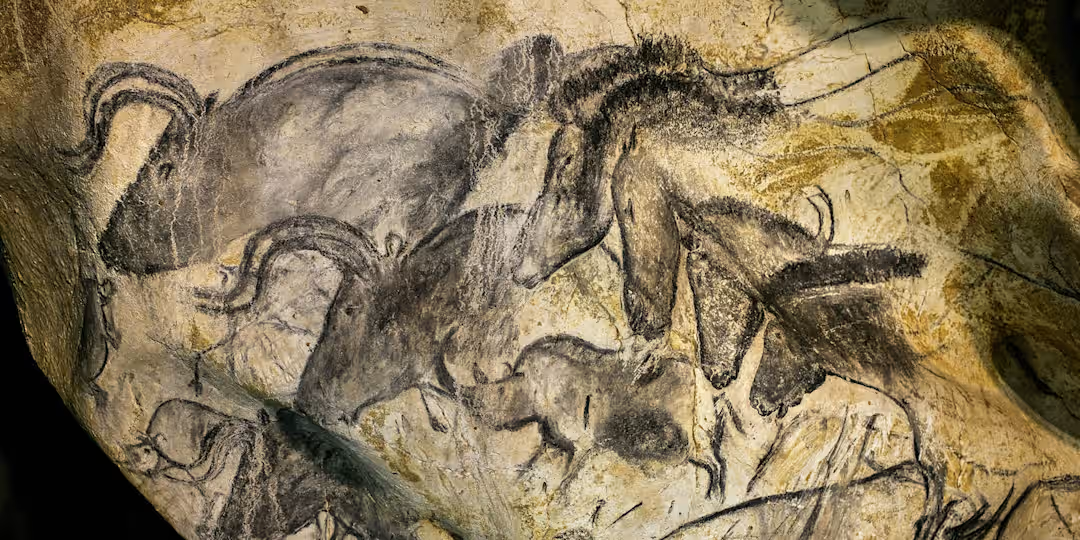
Since the beginning of time, at the core of our human experience has been visuals. The oldest known cave paintings were made at least 64,000 years ago by Neanderthals in the Spanish caves of La Pasiega Maltravieso and Ardales (Little,2025). There are so many cave paintings that portray animals, people, and landscapes that we guess the stories only because we ourselves have not experienced nature as our ancestors have.

An interesting thought regarding cave paintings is whether their lack of current techniques prohibits our capacity to interpret them correctly. Visual storytelling is the combination of emotional reaction and narrative information. The colors, typography, style, balance, and format of an image will generate that first instinctive smile or frown, attracting or repelling the gaze for reasons we don’t fully understand (Losowsky).

Cave Painting

Fine Art Images/Heritage Images/Getty Images

In this cave painting, we see many animals facing the same direction, looking back at us. They vary in size from Rhinos to armadillos, and they all hold a story that only their hunters and companions know. Taking all of these animals in invokes the feeling that the painter created the moments held between the humans and animals out in the wild. The animals were painted with neutral expressions, which makes the painting feel like homage to them. They serve as a reflection of life, what it takes to sustain it and the beings that make it possible. This painting was created through the non-dramatic technique; as its viewers look at the animals, we are to piece together the story.

Seeking New Grounds

Artist: Charles M. Russell

It is interesting how adding more details to a painting helps us understand its context. Unlike the cave painting, this painting put humans and animals together. The wolf that is viewed at the bottom left corner, on its own, we would view as a wild animal. But seeing the wolf next to the humans and their horses, we can understand that this wolf has some level of loyalty to them. Being that it is a pack animal, it has acknowledged that the success of its survival is possible by having close proximity to these humans. All animals and humans are facing the same way, showing unity and that collectively they are all off seeking the same thing. Their horses are carrying their personal items and we see women and children, which makes this adventure seem as they are seeking a new place. The artist controlled the background by adding elements that enhanced the story being told (Gitner,2022). The sunrise in the background evokes the feelings of hope and possibility. The contrast of darker colors are used for the ground that they are leaving for greener pastures.

Rainy Day In Manhattan

Artist:Chin H Shin

Thousands of years later, we’ve moved away from nature to be closer to cities and tecnology. We all love Manhattan when the weather is beautiful, but when it rains, its landscape is completely changed. The outer appearance of large skyscrapers and buildings takes a mysterious tone as the colors are washed out by grey. The colors of the clothes of passersby are cloaked by rain jackets, the flowers on the outdoor carts are brought in, and the storefronts blend into the street sign lights. The dark shading and smudging of colors express how dark and dreary a rainy day in the city can be. The pops of color the artist used for the street and car lights are the only bits of relief from the gloom of this rainy day. We see the group huddled to the left that offers some bright blues, and they seem to be discussing the plans they made now that they’ve met up with each other. The group of people in black seem to have carried the weight of their days and are heading home. They’re hunched forward under their umbrellas, and since the direction they are facing is towards the edge of the painting, the painter communicates that they are not on the same adventure like our friend group to the left. The artist also utilized silhouette’s to communicate the wet grounds and shadows created by the rain. Though this tecnique should be used sparingly as it can be seen as cliche(Gitner,2022), this is an example of how it can add emotion to a visual.

Secret Library

gulistan-blog

The group to the right in the previous picture made me wonder where some of those people could be hurrying back to. During rainy days in the city, the mission is to run home or to our favorite comfort spots. What if this photo is the destination of one of the travelers?

The balance between light and dark in this photo invites us to this secret place. It’s organization and the health of the plants present tell us that someone comes regularly to care for this space. Although the mahogany is dark, the use of lighting speaks of its care; it is all polished, and dust is nowhere to be found. The cherry blossom peaking in through the ceiling has left no flowers on the ground, shelves, or couch for us to find. The artist also used the light to illuminate the book collection which reveals to me this was all brought together because of this caretaker’s love for learning. The artist used this interactive technique for us to find clues while we still remain in a state of mystery. The outside view only reveals more beautiful trees, there are no buildings or streets to tell us if it is out in the country or in a city. This picture invites us to steal away to our quiet place to spend time immersed in the things we love and hold close to our hearts.

Dispair

Artist Unknown

Visual storytelling is important because when our words fail us the use of visuals will always connect us just as music does. We have all experienced this moment in adult life, where all of our responsibilities, our fears, our struggles come in and surround us. There is a feeling of being overwhelmed by the darkness, which is portrayed by the black textured swirl surrounding the stick figure. What this stick figure is feeling speaks to us by how it is on the ground, and it is bent over, trying with its last bit of strength to hold itself up. The pop of red uses color therapy to communicate strong negative emotion amidst the darkness of the black textured swirl. The stick figure’s head points toward the swirl, which makes me believe all of this heaviness is being caused by its thoughts. The red space in the middle holds hope as the black textured swirl hasn’t completely consumed our stick figure.

Woman Immersed In Flowers

Artist:Angel Bird

Moving away from our stick figure in despair, we see how a photo’s message can be changed by its color palette and surroundings. Instead of a black textured swirl, we see a woman surrounded in a field of daisies. She has on a light colored dress, and though we can not see her eyes, her smile conveys that in this moment she is experiencing happiness. Flowers have always been connected to the whimsical journey of being a woman. We see a woman who appears to be at peace with where she is currently in her life, there’s a feeling of acceptance as well. In this moment, everything is as it should be and her joy is her own. Now, if we viewed this woman with the same smile but instead she wore a black gown and was surrounded by a field of black roses, viewers would pick up on nefarious vibes. Feelings of danger would arise as something would feel off.

Person In Contemplation

Artist: Unknown

Another important background choice that effects how a picture is perceived is whether it is set in the day or night. We see a person sitting down, facing away from us as the sunset is completed which reveals a full moon to us. We take the cue that this person is reflecting as we have assigned reflection to night. When the quiet of the day finds us, when everyone has gone to their homes to rest. Seeing someone taking in nature during this time leads us to believe they are processing their life and stole away to do so in peace. If this was located in a city scene, it would no longer be a pursuit of understanding or closure, it would be the beginning to a bout of avoidance.

Conclusion

Throughout history we have used photos to send messages to one another. Strong emotions can be stirred up just by a photo’s color palette, background details and focal points. The artist controls the viewer’s experience by the techniques they choose and by how the present context clues. As we continue to advance and develop new techniques it will be interesting to see how the art of visual storytelling progresses.

Categories
Content Creation

From Planning to Posting: It’s More Than Hair Goes Live

After weeks of hard work, I opened my IMTH Content Schedule and began posting on TikTok. Throughout Week 7, posting my toks was effortless because I already set the expectation as to what needed to be posted and when. I set a repeating alarm for 2:45 pm so that I would not miss my 3 pm delivery times.

Providing authentic content means being actively involved from the planning stage all the way to delivery. Although there are apps that allow creators to schedule posts, due to their formatting issues, I made sure to post my content from my drafts folder myself. I was able to review each tok before and after posting. Any issues with hashtags not appearing correctly or other creator names not linking to their accounts were able to be handled before my audience got a hold of my content.

Week 7 Content Schedule

Content Rollout

I have completed releasing my campaign’s first week of content, and I began seeing the analytics pouring in. So far, the most popular style of tok was my greenscreen tok regarding the Tignon Laws. It’s earned 60 likes, 14 comments, 7 shares, and I gained 2 followers.

Viewers commented that they appreciated my tone as I shared on hair discrimination; they felt comfortable with me and thanked me for spreading awareness on the issue. I made sure to moderate comments that had negative undertones by addressing that my intentions when I created my campaign were not to divide but to offer needed information for those who may experience hair discrimination. I also wanted our allies who may be unaware to be familiarized with the depth of this issue.

Hair discrimination is a heavy topic that I do not want to be used to cause harm; I want this campaign to bring healing and self-introspection. After answering a few negative comments, they balanced out, and the rest of the comments were positive.

Tignon Laws Comments

The next popular toks were my greenscreen toks where I shared other TikTok creators’ hair testimonies. Exposing my audience to the realities of other Black women who positively embrace their natural hair has helped increase natural hair representation. Not everyone will come across black women who wear their hair out in person; far less are they able to talk with them about their hair freely. Viewers may have always had a curiosity about black hair, and other creators sharing their hair testimonies serve as a way to answer any questions or raise awareness.

For years, I have shared my wash day routine and hair products that I create, but it was special to show my audience that I am a part of a larger group of women. We exist in different walks of life, and all have unique experiences that, when shared, can encourage someone else.

One of the creators I posted about, thanked me for sharing her tok with everyone which was the best comment I could get. It’s beautiful that my content has been accepted by someone who also put herself out there to encourage others.

Creator Comment

What’s Next?

I will continue to post my campaign according to my content schedule, and I will monitor the resulting engagement. After tracking post analytics, I will be able to answer which style of posts offer the most engagement, and I will use this information for my next social media campaign.

At the end of my campaign, I will release a thank-you post that will provide closure for my project. The exciting part of finally releasing all of my content is the feedback I will receive from my audience. Maybe the need for another campaign will reveal itself, or maybe they may ask for a continuation of this one. The Crown Coalition may see my work and ask to collaborate, or I might be chosen for a future project by a different organization. That is the fun about creating; it takes you on your own unique journey that can be shared with anyone who encounters it.

Categories
Content Creation

The Fruits Of A Well Planned Creative Process

I began Week 6 by reviewing all of the content that I created for my It’s More Than Hair social media campaign. During my review process, I played each tok and watched for any technological issues that would interfere with its quality. For some toks, they were just as I left them in the draft folder. For others, their caption format changed, and their font style and size were jumbled. I also noticed for some toks that the audio volumes were adjusted from where I set them last week. I’m unsure whether the app has any glitches that would make this possible, but I noted to review each tok during Week 7 that I would deliver.

Week 6 Asana Tasks

Behind The Scenes Rollout

After reviewing all of my campaign’s drafts, I began the rollout of my behind-the-scenes content. On Monday, I released my first post, which explained what my campaign is about as I got ready to film. Get ready with me toks are popular on TikTok, and I wanted my campaign to begin with my audience spending time with me.

A part of a social media project’s success is how quickly an audience will buy into a creator’s brand. Building rapport before my campaign’s release will raise the odds on whether someone will connect and stop scrolling. I released a mix of posts on TikTok, Instagram, and Threads with the goal of maintaining my campaign’s presence on my audience’s for you page.

On Saturday of Week 6, I reviewed all of my post analytics and concluded that the highest engagement was created through my bloopers reel. This tok had a total play time of 24 minutes, 135 plays, 10 comments, and 15 likes. My current followers expressed their excitement to see the rest of my campaign, and I noticed that I received 37 new followers after this tok was posted.

When compared to my get ready with me tok, it recieved 14 likes and no comments. Reviewing these analytics confirmed that having light humor woven in between facts and events will set up the rest of my content to be recieved well.

TikTok Post Analytics

Additional Stories

Due to how well my behind-the-scenes content was recieved, I decided to create additional story content for Tuesdays and Thursdays. My posting schedule was initially set for Monday, Wednesday, and Friday deliveries, but I want to make sure I keep my audience immersed in my campaign.

I created loading screen GIFs that display my campaign’s name and a black woman with natural hair as the logo. These filler stories will have background instrumentals that TikTok will choose when I am ready to post. I also used facts from the research that I conducted to create: did you know, facts, research results, and reminder story posts.

It is important to me not to bog down my audience with heavy statistics from study findings. Mixing logo story posts with short, quick facts on topics my primary posts discuss will keep viewers engaged and not overwhelmed.

In previous weeks, my organization during the planning, filming, and editing processes set me up to have time I could allocate to creating supporting content. It may sound like a lot to create 14 new posts, but managing my execution of tasks helped me avoid the burnout that would have made these additional posts impossible to create.

For these additional story posts, I maintained my campaign’s earth-tone colors and fonts.

IMTH Content Schedule

All of my hard work has been completed and now I look forward to delivering all of my content starting next week. The excitement I feel has doubled since I finished filming and began editing. I’ve done a great job of managing myself when I feel tired, but I am aware that I must manage my excitement.

Once I start posting my content, I might want to rush ahead and post ahead of schedule, and then it clicked. I needed a content posting schedule to hold myself accountable with, which will ensure that I don’t run ahead of my initial plans.

I created my content schedule so that I can also visualize what needs to be done during the delivery phase. Organization helped me free up time to create more quality content, so I believe during delivery it will help me stay on task. It will also help me understand my post analytics once they are made available to me.

Posting Schedule

Production Journal

I realized that once I finished editing, my total hours towards my project have steadily decreased each week after. Week 6’s tasks took me a total of 15 hours, even though I created more content.

This project taught me that creating a plan for a project is the best thing you can do to ensure its execution. But it also helps with inspiration and filling in the gaps of what is needed to make a project whole.

Creating my production journal for this week showed me the fruits of adapting to my project needs while prioritizing rest and recovery. If I did not rest last week when I finished my tasks early, I do not believe I would have had the energy this week to create content.

I reviewed my previous production journals and smiled as I saw them get shorter and shorter, just as my Asana task list did the same.

Production Journal

Conclusion

As I look towards Week 7’s content delivery, I am at peace with the content I’ve created. I am certain that any social media campaign I create moving forward will be set aside as authentic because of this undeniable experience that has left its impression on me. The way I create has been altered to a more strategic approach, and I wholeheartedly believe that deep research belongs at the beginning of every creative project.

Week 7 Asana Tasks

Categories
Content Creation

Entering The Final Stretch

When I opened my Asana to begin Week 5’s tasks, I paused for a brief moment and reflected on my project’s journey. Although a lot of work was done to bring me to this moment, it felt as if it were all a fever dream, and the light at the end of the tunnel shone brightly within reach.

Week 5 Asana Tasks

Content Editing

Last week I created the draft files for each tok I will make and attached my footage to each file. This was a great strategy because a week later I did not have to try to remember which footage should be used for which tok. Instead I opened my first tok’s draft on my right monitor and tracked my editing checklist on my left monitor.

I printed out my content drafts artifact for me to write notes as I conducted my first view of a tok’s raw footage. Here I noted whether audio levels needed to be adjusted and what overlay footage would need to be added. As I mentioned in my previous blog post, I enjoy crossing things off on paper more than digital completion so physically writing out editing tasks and crossing them off as I worked made the work feel more fulfilling.

Draft worksheet

During the editing process for each tok I adjusted the audio levels of my footage to be louder than my background music. Once I found the appropriate levels I selected the option to apply the volume level to all of the footage in the tok and I took a screenshot to apply those levels to my other toks as I went along. I want to have uniform sound just as I’ve had uniform earth-tone colors for this project.

Tik Tok Editing Process

After completing the technical editing of adjusting sounds and clipping footage to flow into transitional effects. I watched the tok a second time to complete my editing checklist. This checklist focuses on spelling, grammar, and fact accuracy. It also confirms whether I have the correct post captions, hashtags and close captions.

This checklist forced me to slow down and immerse myself in my work. It is easy for me, when I am tired, to believe that everything looks good because I want to finish for the day. Creating systems such as my editing checklist helps me ensure that I catch any human errors I may have made that would interfere with my finished campaign’s quality.

Editing Checklist

Behind The Scenes Content

Week 5 felt different as I did not do as much heavy lifting as I did in my previous weeks. The majority of my time was spent editing my toks but once that was completed, I realized something was missing.

My social media campaign includes 21 high-quality toks, but there was nothing in place to ensure a smooth rollout. As I edited, I decided that for Week 6 I should release some behind-the-scenes footage to gain the attention of my audience. Viewers love sneak peeks at projects because it makes them feel included, and they also feel as though they are spending time with the creator.

Using Sprout Social’s post schedule recommendations, I set the schedule for Week 6’s posts to span between Monday, Wednesday, and Friday afternoons. I will be utilizing TikTok and Instagram/Facebook stories along with Instagram’s Threads app. For story posts, I will include photos I took during the filming process as well as snapshots of my work in TikTok’s editing tool. Threads would be used for me to describe my social media campaign while notifying my audience of its arrival to social media platforms. The last post I have scheduled for the Friday before delivery would be a blooper reel. I want my audience laughing and open to my campaign before its launch.

A lot of work was put into my campaign, and I believe having a pre-launch of content will set it up for success just as much as my editing styles, captions and hashtags will.

Behind-The-Scenes Artifact

Project Journal

The preparation I completed for this week allowed me to get all my needed tasks completed, including creating behind-the-scenes content, under 20 hours. I thought editing was going to take as long as filming did, but the organization of my raw footage saved me so much time.

I also believe that because I’ve completed alot of the tasks I needed for this week in previous weeks I’m already familar with what is needed. Yes, I read four articles but because I read similar material during the planning stages, I was refreshing my memory. It’s easier to go through the motions when there is muscle memory in place.

Once I completed everything that I needed for Week 5 I decided to rest and prepare for Week 6’s review process.

Week 5 Production Journal

Conclusion

Hard work pays off when it is structured and has a sustainable pacing. Throughout this project I have learned the importance of being able to pivot when opportunities present themseleves. The addition of behind the scenes content was made possible because of Week 5 being planned out so well. I updated my Week 6 tasks to include the roll out of my behind the scenes content. There’s just two weeks left until I roll out my complete campaign and I look forward to seeing its success.

Asana Tasks Left
Categories
Content Creation

Successful Content Begins Before Filming

Throughout the planning and research stages, I looked forward to Week 4 the most, because it would be where I would bring every script to life. When I opened my project management plan in Asana I felt my excitement rise when I saw that it was finally time to complete my content creation task.

Week 4 Task List

Continue Gathering Tok Inspirations

Following my process of starting with the task with the fewest subtasks, I began to continue to gather TikTok Inspirations. For one hour, I researched TikToks in order to gather hashtags or editing style tips and added relevant toks to my TikTok Inspirations artifact.

This week’s research provided tips on how to deliver dense information to audiences in a manner that they can receive it. A creator in one tok that I found had a cadence of a news reporter without having the commercial tone most reporters carry on broadcasts. This stood out to me because it solidfied that I need to memorize the information I will be discussing so that it flows out. Stumbling over dates, names, and historical facts will discredit my work as viewers will question whether I am confident about the information I am relaying to them.

I also found a creator who wrote the topic she would be discussing out as a text sticker and left it suspended above her video. For toks where having captions would be too hectic and distracting I can implement this trick so that the algorithm can identify what my tok is about and push it out to the correct audiences.

Another creator I discovered shared the moment she made the choice to abandon wigs to wear her natural hair out. Although a lot of what she discussed was serious, I recognized her information delivery pattern: serious statement, reasoning, humor. One example of this delivery method was a shot where she shared her realization of the anxiety she faced regarding how differently she would be perceived by others. She shared that she knows that is out of her control, and what she needed to fix was her perspective of wearing her hair instead of pursuing protective styling. She then zoomed in to deliver a light-hearted joke, zoomed out after the joke landed, then edited to her next shot.

Hair discrimination is a heavy topic that I want to give my audience breaks to breathe and process the information I am giving to them. This will be done with balance because too much humor will undermine the impact of my toks, while delivering statistics and facts only will make a viewer scroll to their next tok to view.

TIkTok Inspiration Artifact

Content Creation

Creating 21 toks seems overwhelming when the execution of filming them is up in the air. Once I completed my TikTok research, I created my Post Creation Plan so that I can navigate what needs to be created on Canva and manage the footage that needed to be filmed.

I took each Week Post from my Script artifact and then organized them into these categories: interactive stories, carousel posts, story time green screen posts, and did you know posts.


Although I have all of my toks that I need to create listed as subtasks under my content creation list. I printed my Post Creation Plan because sometimes crossing off tasks on paper is more satisfying than digitally completing them.

Paper Post Creation Plan

After creating all of my post drafts in TikTok, I reviewed my marked-up Post Creation plan and accounted for each draft in TikTok by completing its electronic Asana task. This may seem as double work but when coming down from the adrenaline rush that recording film causes, I wanted to confirm I had everything I needed filmed to limit any surprises during Week 5.

Asana Subtasks

Once I completed all of my TikTok Drafts I created my Content Draft artifact which features each draft’s thumbnail, whether or not it is located in my draft folder and what intended audio will be used. TikTok does not allow for stories to be saved as drafts so I did mock stories to see how everything would look visually and to decide what audio I would want to use and included their screenshots. Next week when I begin editing I will use my Content Draft and TikTok script artifacts to confirm I delivered the correct lines, captions, hashtags and audio sounds.

Content Drafts Artifact

Create Production Journal

Something that I have learned throughout my social media campaign project is that repeative tasks help maintain the flow of the project. Completing my hour of TikTok research and its artifact came naturally because I’ve already done that last week. It was the same for completing this week’s production journal. I was able to keep my repetitive tasks from last week and then filled in work specific to Week 4’s needs.

Before filming, I re-read the articles that pertain to the subjects I would be discussing in my toks. I realized that because I am attempting to learn the lines of my script, instead of freestyling, the memorization of the lines was easier because I already reviewed all of the supporting information.

I knew that filming my content would have the greatest demand this week so just like my scripts, I dedicated the most time to film and I made sure to spread it out across the week to avoid burnout.
Due to this week’s heavier task demand it was no surprise that my production journal for Week 4 was much greater than last week’s.

Production Journal

Conclusion

Although Week 4 was my most demanding week, it was also my most fufilling week. All of my hardwork I’ve done before film was appreciated every step of the way. When it came time to film for the day, I already knew what I would wear for my toks. I was able to limit my stress during film because I was not blindsighted by any unplanned demands. Having an understanding of what needs to be done and in which order allowed me to allocate all of my attention and energy to the task at hand. After completing all my tasks in Asana for Week 4, I now see the light at the end of the tunnel. I have cleared the hump of my project and now it is to complete editing and review.

Asana Weekly Tasks

Categories
Content Creation

Structure Is Essential for Creative Projects

The start of this week was set up for success as soon as I completed my project management system. When I opened Asana to review this week’s tasks for my It’s More Than Hair campaign, I was given a clear understanding of what needed to be done.

Week 3 Task List

Continued TikTok Research

For one hour, I researched existing TikToks to obtain ideas for hashtags and editing styles. During my research, I added any toks I would refer to in my TikTok Inspirations artifact. For each selected tok I recorded its URL for future utilization. I also included detailed notes on what the tok discussed and how I will use it to ensure the creation of high-quality content for my campaign.

From this week’s research, I concluded that I will have my educational toks outdoors. Afros have been compared to treetops due to how full and round they can be. Delivering an educational tok under a huge tree will play into this concept. I also saw examples of captions being used at the top of videos or used as a divider between a narration video and supporting photos.

My goal is to offer a diversity of content. I want there to be a healthy mix of editing styles, so I will make sure to rotate my caption placement according to my toks’ specific needs. Another editing tool that I encountered through other creators is the utilization of a green screen, where I can appear on top of my supporting photos and video. Kaylatheshow created a tok where she added her supoprting content as stickers that pop in and out while she spoke.

My main goal is to hold my audience’s attention while not losing my video’s authenticity. These editing styles will assist my content’s success.

Continued TikTok Research Artifact

Create Production Journal

In creative industries, it is a standard practice to hold weekly production meetings. It provides team check-ins to ensure projects are moving along smoothly and that team members are on track. Creating a production journal helps creators hold themselves accountable to their workloads while providing documentation other team members can use to assess what still needs to be done.

When creating my production journal, I wrote out all of my listed Asana tasks first and then filled in supporting tasks. I chose to allocate 20 hours towards my project this week, and I split up that time amongst my tasks. Knowing that creating my 21 TikTok scripts would have the heaviest demand I allocated 10 hours to it, this translates to 2 hours per day (Mon-Fri).


To obtain my duration times, I ran my iPhone’s stopwatch to ensure that I did not go over my allocated times. This helped me eliminate the burnout I would have experienced if I dedicated one day to writing out all of my scripts. Another benefit of this approach was that I worked on different areas of my project, so forward motion was apparent because lighter tasks were being completed first.

Something that a project management system and a production journal share is the sense of fulfillment once they are completed. It takes a lot of hard work to put together quality projects; it is easy to get lost in the process. But when you can look at a physical representation of the work done, it helps keep morale and motivation up.

Production Journal

Drafting My Artifacts

Before this project, I had created my TikTok content without any scripts. I’ve left all that I have to convey for the day of filming. Although freestyling has worked for me on other projects, I wanted a more structured approach for, It’s More Than Hair. I will be sharing a lot of dense information, and I want to make sure that what I share is accurate and is delivered in a manner that my audience can receive it.

Writing out captions, intended hashtags, story arcs, call to actions, and film notes is just the same as creating my project management system or production journal. When it comes time to film and I get lost in wardrobe, going to film locations, and setting up equipment, I will have something to refer to that will keep me on track.

I created a template for my educational toks using TikTok’s recommended story arc:
Beginning- Hook
Middle- Name 3-5 points
End-Call to Action

Using this template made writing out my scripts an easier process because I knew what I needed to write out for each topic. They came together more cohesively than I initially expected, and I know I have a plan for my film days.

Once I finished writing out a script, I found supporting photos and video I would want to use and added them to my photo and video archive. I also included the URL for each archive listing so that if a photo of video breaks, I can go back to the original source and obtain a new copy. I also want to include photo and video credits so that other content creators and artist may recieve their credit for their work.

Education Post Script

Conclusion

It has been an interesting experience attempting a creative project through a structured approach. There has been a lot of work involved in planning and drafting the intended content of my social media campaign. But I know next week, when I execute filming the content, all of my current hard work will pay off. What a gift it is to start Week 4 of my project with excitement versus exhaustion and confusion.

Categories
Content Creation

Project Management & Research: A Successful Project’s Foundation

Creating a social media campaign that educates on the history of hair discrimination, the laws that make it possible, the laws that will make it illegal, and the toxicity of the black hair care industry will need structure. Now that my project proposal has been approved, I took the time to set up my project’s management system through Asana.

What is project management?

Ensuring the success of a project does not end with completing its proposal. Completing a project management plan helps creators brainstorm the execution of their project. I chose Asana because of how user-friendly it is. After assigning a name to the project, I made each week a section, then broke down the week into tasks that need to be completed. To those tasks, I added sub-tasks which are the actions that are needed to complete a task.

Week 1 & 2 Task Board

Being able to visually see my project in front of me helps me to accurately set my expectations of what is needed from me for each week. It will also help me avoid creative burnout, which occurs when a project’s workload is not properly dispersed. How I organize my weekly task list is by how many subtasks each task has. I will start on the task with the fewest subtasks first. Then I will tackle the task that has the highest subtasks, next will be the task that has the second highest number of subtasks, in that order until I complete all of my listed tasks for the week. Getting the easy tasks out of the way first helps me to tackle my more involved tasks while feeling fulfilled. This serves as encouragement to continue working my project plan.

Subtask counts highlighted in yellow

Throughout the execution of my project, I will be pulled in different directions, so when I create tasks, I will write my initial thoughts in the descriptions so that I am reminded at the time of completing the tasks. I also utilize the comment section to write any observations made during the execution of a task, so that I can have an improved approach the next time I need to complete a specific task, or if I do a similar project, I have notes on what worked and what didn’t. I also appreciate that Asana has the feature where once I set up a task and its subtasks, I can duplicate it. This saves time and helps me build my weekly tasks to be completed uniformly.

Creating Duplicate Tasks

Keeping track of the work that needs to be done and the work that has been done provides the clarity that creators need to complete successful projects. Adding structure to creative projects may seem like a lot of work and that it would take the fun out of the creation process. But, I encourage you, if you haven’t utilized a project management system during a creative project yet, to try it. Your projects will thank you, and your audience will see the quality of your work increase.

More Research

As I completed my project management plan, I allocated time during Week 2 to continue my research. The focus of my continued research was on how I can ensure that I am setting my content up to be successfully received on TikTok. For this, I looked at articles TikTok provided in their Creator Academy. Current content creators and advisers who work for TikTok offered advice on how to create successful content on the platform.

TikTok created its algorithm to reward authentic content, this means that how many followers or likes a tok gets isn’t considered. The content that the algorithm pushes out to larger audiences hold viewers’ attention and adds value to their app experience. Yes, a tok’s success depends on its first 3 seconds which is why creators recommend having a ‘hook’ in the beginning of the video. But having a ‘hook’ doesn’t mean spreading misinformation or toxicity for views. This means perfecting the art of storytelling.

Storytelling toks are the most successful on TikTok because users want to feel as though they’re being included in a conversation with creators. They don’t want to experience any facts being thrown at them or old school interruption marketing. The blueprint for a successful story arc is to have a hook, 3-5 facts on the topic being discussed and a strong call for action. During Week 3 when I create the scripts for my toks I will make sure to implete story arcs that will serve as the strucutre of the information I want to share with my audience.

TikTok Best Practices Playbook

During my TikTok research I also learned that setting my content up for success requires me to include closed captions. This helps the algorithm pull key words stated for it to recommend the tok to people interested in those words in other content. It is important that I include relevant hash-tags to all of my toks so that the algorthm will also know where to send my tok. During Weeks 3-4, I have set aside 2 hours for continued TikTok content research. I will view other creator’s content that discusses the topics I will be sharing on. On their successful toks I will write down the hash-tags that they used so that I have the best hash-tags for my own toks.

Conclusion

Having a plan while creating has granted me clearer focus and I am able to be my best self through my planning. Researching how to have my content be successfully recieved helped me hone in on how I will create my scripts, locate my hashtags and write my captions. I’ve started on my Week 3 tasks and can already tell the difference because I know what needs to be done, I have eliminated any guesswork.